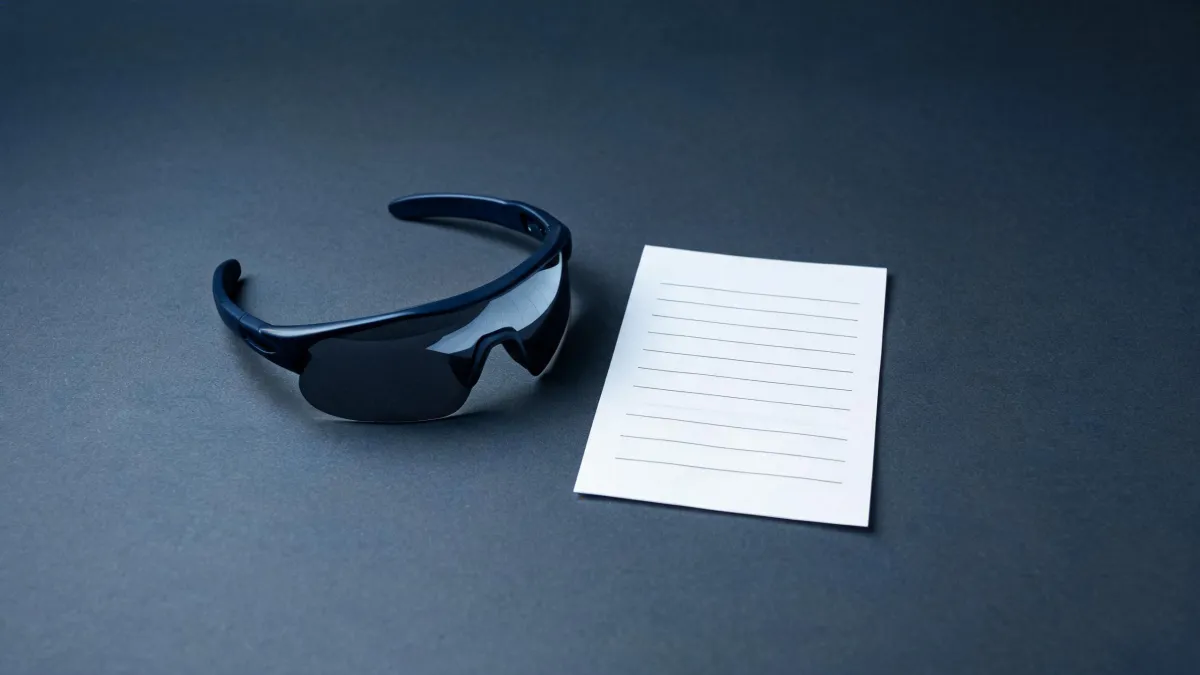
I'm the quality and brand compliance manager at a golf eyewear sourcing company. I review every sample and production batch before it reaches a customer—roughly 210 SKUs annually, plus the prescription side of the catalog. In 2024, I rejected about 17% of first deliveries, mostly over lens tint variance and frame geometry that sat just outside our spec. So when buyers ask whether they should add stock golf sunglasses or a prescription golf eyewear program to their line, I have opinions—backed by rejected batches.
Let me be clear upfront: these aren't competing products. Stock (plano) golf sunglasses and prescription golf eyewear solve different problems for different customers. But the sourcing decision around them gets muddy because most comparisons focus on the wrong criteria—retail price, catalog size, brand name—instead of what actually determines whether a program works.
Here's what I'll compare, side by side: optical consistency and lens standards, supplier base and MOQ realities, market fit, and return economics. I'll tell you where each wins, and where I've watched both go sideways.
The two options, briefly
Stock golf sunglasses (plano, non-prescription) are the familiar product: polarized or non-polarized lenses in a sport frame, sold through pro shops, retail, promotional channels, and gift programs. Men's polarized styles dominate the volume.
Prescription golf eyewear is the same category with an Rx lens inserted—single vision or progressive—sourced from a factory that can grind, coat, and edge to optical tolerances. It serves the golfer who wears prescription glasses and doesn't want to fuss with contacts or clip-ons during a round.
The sourcing question isn't "which is better." It's "which one fits the commitment you're prepared to make." Here's the breakdown.
1. Optical consistency and lens standards
From the outside, prescription golf sunglasses look like stock sunglasses with a different lens slipped in. The reality is that Rx eyewear introduces a second manufacturing chain with its own tolerances—and that chain fails differently than plano does.
For plano golf sunglasses, the relevant standards are EN ISO 12312-1:2022 in the EU and ANSI Z80.3-2018 in the US. They define lens filter category (0–4), UV transmission limits (UV400 blocks up to 400nm), and optical clarity requirements. Power tolerance in the central zone is fairly tight—typically around ±0.08 diopters—but the harder part is tint consistency across a batch. If you source 5,000 units of a copper-gold mirror lens, they need to read within roughly Delta E < 2 of each other, or customers notice on the shelf.
For prescription golf eyewear, you're layering EN ISO 8980-1:2017 (single vision) or 8980-2:2017 (progressive) on top of the sunglass standard. That means the lens has to clear two bars: cosmetic accuracy as a sunglass, optical accuracy as an Rx lens. In my experience, this is where newcomer suppliers underestimate the QC burden. A plano factory can run a spectrophotometer across a batch and call it done. An Rx-capable factory needs a lensmeter per unit and a verifiable record for every pair—otherwise you can't defend the product if a customer complains.
The frustrating part: the same tint variance that's a minor annoyance in plano becomes a failure in Rx, because the patient—not just the buyer—is now comparing left and right lenses. You'd think written specs would prevent this. Interpretation still varies wildly.
Verdict: Plano wins on simplicity and inspection cost. Prescription wins on perceived value—but only if the supplier can show verifiable per-unit Rx QC. If they can't produce lensmeter records on request, walk.
2. Supplier base and MOQ realities
Most buyers focus on the factory's published MOQ and completely miss the plano-only vs. Rx-capable split. Not every golf sunglasses factory can do prescription work—the lens grinding, coating, and edging equipment is a separate investment, and the QC overhead is materially higher. This matters because it shrinks your supplier pool from "many" to "few."
For stock golf sunglasses, especially men's polarized styles, MOQs of 300–600 units per colorway are common, and sample lead times run 7–14 days. For prescription golf eyewear, MOQs often land at 500–1,000 units per SKU because lens blanks must be ordered in production quantities and coated as a batch. Lead times stretch to 25–45 days, sometimes longer if you're specifying a custom tint or mirror.
Here's the part that catches buyers: an Rx program usually requires you to commit to a lens catalog before you know which prescriptions will sell. Progressive vs. single vision. Base curve range. Whether you also stock plano. Get this wrong and you'll sit on inventory that doesn't match demand.
Verdict: Plano is the lower-commitment option. Prescription is higher-commitment, but it's the only way to serve the golfer who can't wear stock sunglasses over contacts—a real, underserved segment. I've seen brands win meaningful shelf space precisely because they were the only ones in their region with a prescription-capable men's golf line.
3. Market fit and the counterintuitive order flow
The question everyone asks is "what's our margin?" The question they should ask is "who is this product actually for?" The two options serve different buyers.
Stock golf sunglasses fit the bulk of the market—casual and intermediate golfers, pro-shop retail, tournament giveaways, corporate programs. Volume is predictable and price compression is real. Here the differentiator is design and tint, not optics.
Prescription golf sunglasses fit a narrower but stickier segment: committed golfers who wear prescription eyewear and don't want to switch to contacts for a round. That's a meaningful slice of adult golfers in markets like the US—in the range of roughly 30%, based on participation data the National Golf Foundation published in 2023. (Verify current figures at ngf.org.) These customers are less price-sensitive and more loyal to whichever brand actually solves the problem.
The counterintuitive bit: the prescription customer often buys both. They buy an Rx pair for play and a stock pair as backup or for casual wear. So an Rx program doesn't cannibalize your plano line—in our channel, it feeds it. Buyers who assume the opposite leave volume on the table.
4. Return economics and the 90-day test
Post-decision doubt is real here. I once approved a prescription rollout and immediately thought, "what if progressive uptake is 3% instead of 15%?" Didn't relax until the reorder curve at the 90-day mark came in above plan. That's the timeline to plan around—not the launch, the reorder.
For plano, returns are usually cosmetic or fit-related, and our channel sits at roughly 3–5% on men's polarized styles—manageable. For prescription, returns are higher, around 7–12% in my experience, because fit and optical adaptation issues compound. A wrong pupillary distance or base curve can send a pair back even when the frame is perfect.
Dodged a bullet last year when we re-checked the base curve spec before a 2,000-unit Rx run. We were one signature away from approving a base curve that would have failed roughly 40% of wearers on wrap-style men's frames. The redo would have cost five figures and pushed the launch past spring golf season.
Verdict: Plano returns are cheap to absorb. Prescription returns are expensive and slow—but they're manageable if your supplier builds in the verification step before the run, not after.
Which option belongs in your B2B line?
Both, in the right sequence. Here's how I'd frame the decision:
- Choose stock plano golf sunglasses if: you're building volume, targeting pro shops or promotional channels, or testing a new channel with limited commitment. Lower MOQ, faster lead times, simpler QC, and you can iterate on designs quickly.
- Choose prescription golf eyewear if: you already have a loyal customer base with real Rx demand, you can support longer lead times and higher MOQ, and you have (or can build) a QC process for per-unit verification. It's a commitment—but it's also a moat if you get it right.
- Sequence for both: launch plano first to prove the channel and build the customer list, then layer the Rx program onto the best-selling frame shapes. This is the path most brands we work with settle into, and it's the one that minimizes the risk of sitting on unmatched Rx inventory.
The industry has genuinely evolved here. In 2018, a "prescription golf sunglasses" program was mostly a marketing claim bolted onto a plano catalog. As of early 2025, the capable suppliers run dedicated Rx lines with verifiable per-unit lens records, and the bar for what counts as "Rx-capable" has moved up. What worked five years ago—sourcing from a general sunglass factory and assuming they can handle Rx—no longer holds up.
The fundamentals haven't changed: good sourcing is still about specs, consistency, and QC you can verify. But the execution has transformed, and buyers who still treat prescription golf eyewear as an afterthought are leaving a real segment to whoever moves first.
